
Project Title: Evaluating ocean alkalinity enhancement in coastal waters
Supvervisory Team: Tyler Rohr, Max Rintoul, Lennart Bach, Nadine Lehman
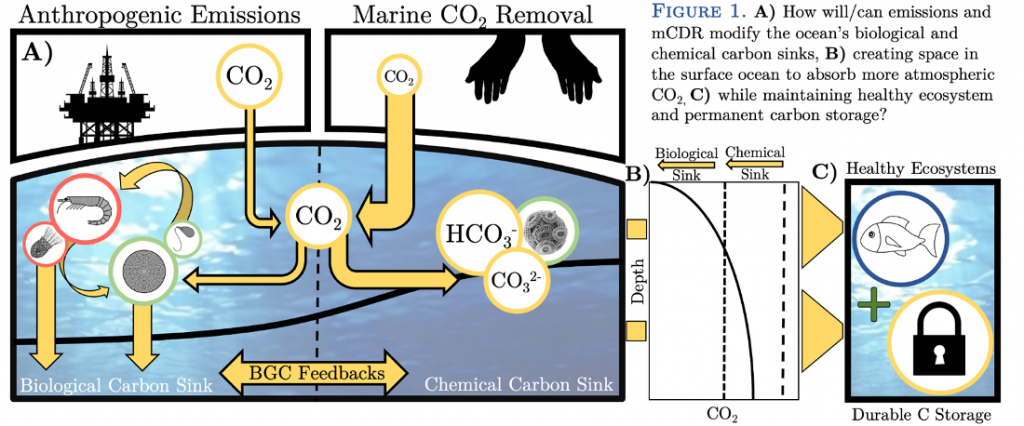
To inquire, contact: tyler.rohr@utas.edu.au
~~~~ See bottom of page for application intructions ~~~~
Project Description
To limit global warming to below 2°C, all IPCC mitigation scenarios rely on large-scale carbon dioxide removal (CDR). Ocean alkalinity enhancement (OAE) is a promising marine CDR approach already being trialed and commercialized. By increasing seawater alkalinity, OAE enhances the ocean’s natural capacity to absorb CO2, where it can be stored for ~100,000 years1.
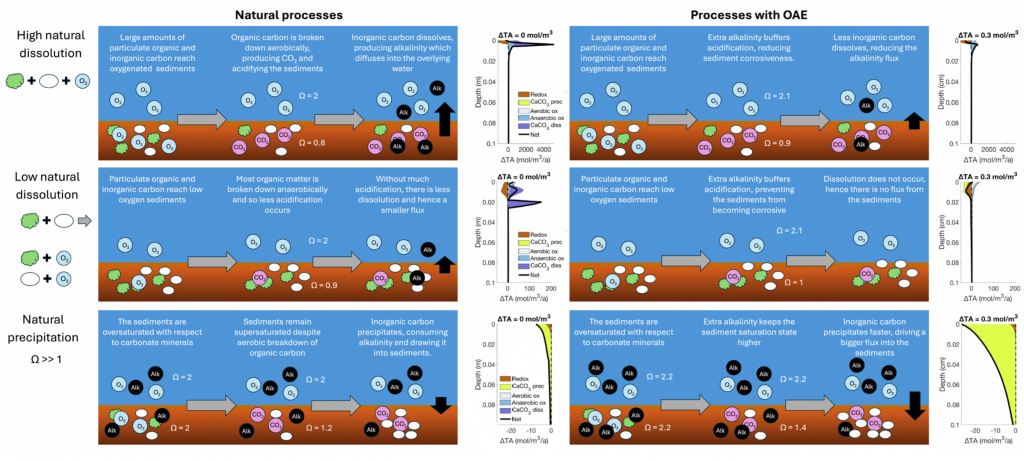
Most current OAE efforts take place in coastal waters where existing infrastructure lowers deployment costs. In these settings, alkalinity-enhanced water encounters seafloor sediments quickly. Sediments naturally generate alkalinity through calcium carbonate dissolution. However, increasing water column alkalinity may slow or reverse this dissolution, suppressing this natural flux2. Some of the anthropogenically added alkalinity would therefore be replacing alkalinity that would have been produced naturally. This reduces the “additionality” of OAE—the net carbon removal achieved beyond what would happen naturally.
The extent of this additionality loss depends on both how OAE is performed (e.g., dissolved versus particulate alkalinity sources) and on local sediment properties. Dissolved additions may cause smaller, more diluted chemical changes, incurring smaller additionality costs. Conversely, particulate materials dissolving directly on the seabed may induce much stronger local chemical modifications and produce greater additionality costs. The sediment type is also important, with sediments with high natural alkalinity production driven by calcium carbonate dissolution being especially susceptible to reduced fluxes, while sediments with low natural fluxes may be less affected.
This project will determine how sediment–water interactions influence the true efficiency of OAE – and how additionality costs can be reduced.
Chapter 1
Using a 1D sediment biogeochemical model modified from RADIv13, the student will simulate a range of OAE deployment strategies and sediment types to quantify the resulting changes in benthic alkalinity fluxes. By clarifying how sediments interact with alkalinity-enhanced waters, this work will identify conditions and strategies that maximise OAE’s effectiveness, providing actionable guidance for future OAE deployments.
Chapters 2 & 3
Benthic models vary largely in their complexity4 and are poorly constrained by observaitons5. Complex diagnetic models with enough biogeochemical resolution to accurately quantify additionality costs are rarely coupeld to the hi-resolution, coastal 3D ocean models needed for OAE carbon accounting6,7. None include any representation of secondary preciptation in the sediments8
Chapters 2 and 3 may explore novel methods to integrate a proccess-rich sediment model (Chapter 1) into coupled 3D ocean-biogeochemical models – and ultimately more accurate accounting frameworks for coastal OAE.
Methods may invole direct coupling, offline forcing and/or statistically simplified sediment sub-models trained on the full 1D model. The student will colaborate will biogeochemcial modellers and software engineers at CSIRO to aid with model development and implementation. No prior model development experience is required.
Outcomes
Through this project the student will gain expertise in numerical modelling, carbonate chemistry, and coastal biogeochemistry, and contribute to an international effort to determine if and how OAE could be deployed to safely abate the worst impacts of climate change.
The student will likely collaborate with laboratory/field scientrist to help parameterize the model and regional ocean/BGC modelers to integrate the sediment model into 3D coastal systems.
Potential Collaborations/Affiliations
Future Oceans Centre of Excelence
While based at IMAS, this PhD project will likely be affiliated and heavily involved with the recently funeded Future Oceans Centre of Excelence (CoE). While not guranteeded, this affililiaition would likely include a Top-up scholarship, access to additional travel funding, and opportunities to collobarate across a great team scientists across UNSW, UQ, ANU, UWA, and UTas.
Internship
As part of the the Futrue Oceans (CoE), there also may be an opportunity for a succesuful candidate to participate in an internship with one of the Centre’s Industry Parters. In particular, there may be an opportunity for Isometric to host the PhD student for 3-6 months to learn first-hand the role ocean scientists play in carbon removal verification. This student may conduct supplier site-visits, conduct in-situ environmental monitoring, and/or help develop scientifically rigorous protocols for quantifying/ verifying carbon removals, helping them to translate research outcomes from their thesis into industry impacts.
SedBGC-MIP
The Sediment Biogeochemistry Model Intercomparison Project (SedBGC-MIP) is a community-driven initiative funded by US-OCB office, led by Samantha Siedlecki. It is aimed at comparing existing and new benthic models against observational constraints to refine key parameterizations and assess structural uncertainties. This support will help grow a more vibrant, international benthic modelling community and will likely include opportunities for the student to engage at workshops, webinars and conferences.
Field Work
This project will be co-supervised by Lennart Bach and Nadine Lehman who lead several exciting obersvantially based OAE projects at IMAS. It is possible the student could have the opprtunity to collaborate with their broader team to help make measurments in the lab or field that will be used to help constrain the sediment model.
How To Apply
To apply, please email the following to tyler.rohr@.edu.au
- Curriculum Vitalae (CV).
- Contact Information for 2 References. Can be incldued in CV
- Relevant Academic Transcripts
- 1-2 Page Cover Letter. Detail why you are interested in this project speciffically and defend why your background makes you a strong candidate. Prior experience in carbonate chemistry and/or biogeochemical modelling is preffered but not required. Only a strong analytical foundation and an eagerness to learn.
- Sample(s) of Scientific Writing/Research. This could include peer-reviewed publications, a Masters/Honours thesis and/or an unpublished/unsubmitted draft of either. At least one must be as first author, but feel free to include any additional work for which you made a major contribution (with an annotation on what that contributuion was)
- Project Description. This is only required for the top-ranked applicant in the formal submission to the university. This will largely be provided by the supervisory team (essentially this text) but modificaitons/insights from the student are welcome.
Application Deadline: January 27, 2026
Application Process/Timeline: After receiving application material the supervisory team will interview the most competitive candidates on a rolling basis. Final applications need to be submitted to UTas by Feburary 1st – including information from the interview (provided by supervisory team). The superviosry team will then select the top candidate to proceeded through to the competitive scholarship round. We will notify all canditates of that decisions by Feburary 1st. The top candidate will be assessed across candidates to all universtiy-wide projects and be notified by April 13 if they received a scholarship. We will work work the candidate to make sure the application that goes through to the univesity is as competitve as possible. If succesful, the start date for domestic and international students should (ideally) be prior to June 12th and Oct 26, respectively.
References
- 1NASEM Research Strategy for Ocean-based CDR (2021). Chapter 7.
- 2Bach (2024). 10.5194/bg-21-261-2024
- 3Sulpis (2022). 10.5194/gmd-15-2105-2022
- 4Siedlecki (2025). 10.5194/egusphere-2025-1846
- 5Schultz (2025). 10.1029/2025GB008643
- 6Laurent (2025). 10.5194/egusphere-2025-3361
- 7Fennel (2023). 10.5194/sp-2-oae2023-9-2023
- 8Fuhr (2025). 10.3389/fclim.2022.831587