
John has a new paper out today in JGR: Oceans on the complex role of eddies on productivity in the EAC
Environmental Controls on Eddy-Induced Chlorophyll-a Anomalies in the East Australian Current System
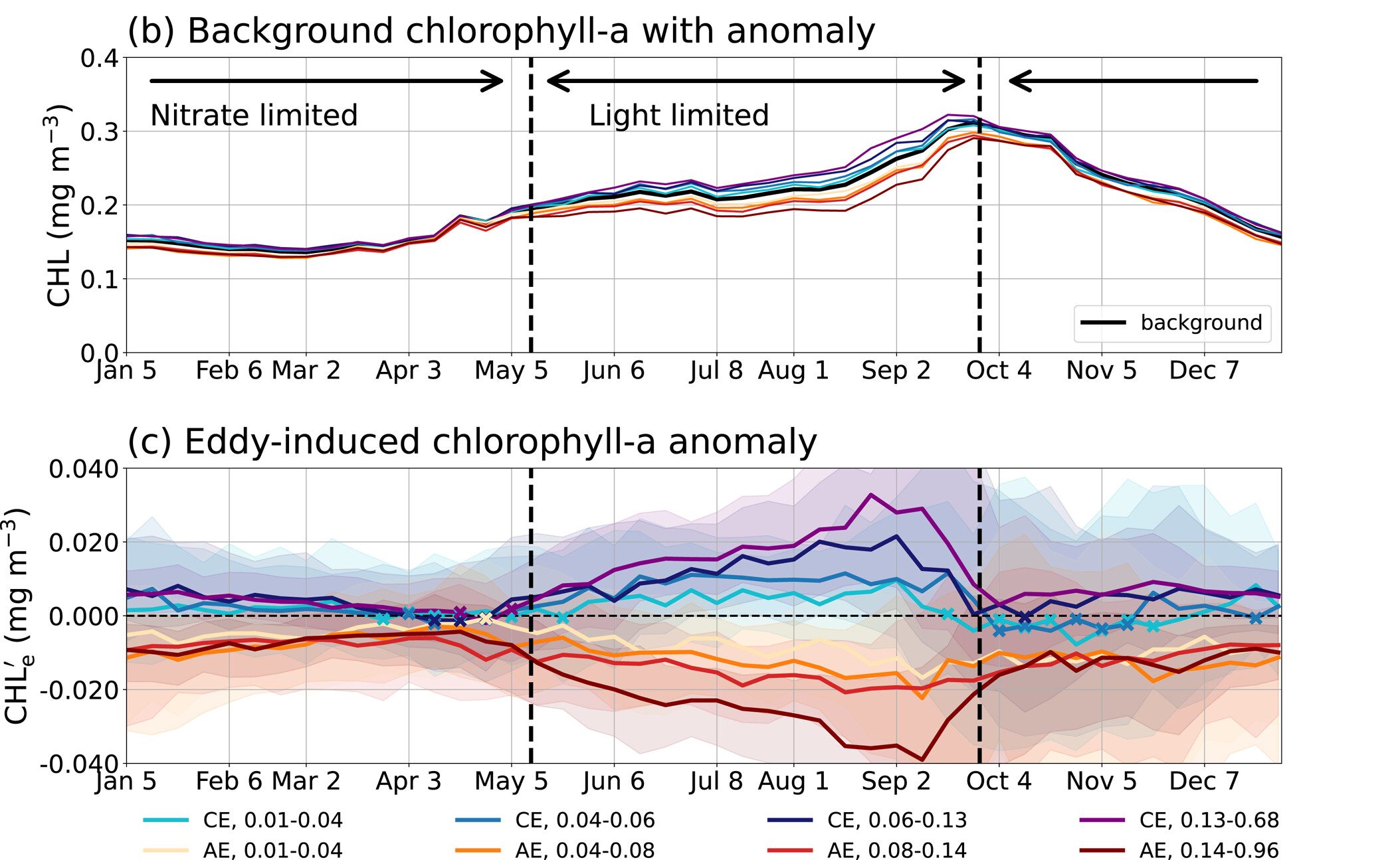
Abstract: Mesoscale eddies in the East Australian Current (EAC) system modulate phytoplankton growth via different mechanisms. Long-term averages of elevated and suppressed chlorophyll-a in cyclonic and anticyclonic eddies have been attributed to eddy trapping and pumping, but their seasonal variability remains less understood. Using 19 years (2003–2021) of satellite altimetry and chlorophyll-a with in situ climatologies, we show that seasonal changes in the magnitude and sign of eddy-induced chlorophyll-a anomalies are influenced by background light availability, nutrient supply, and stratification. We identify three EAC sub-regions with contrasting environments, each exhibiting distinct seasonal cycles of chlorophyll-a anomalies. In the core EAC, during a light limited, weakly stratified period (May–October), eddy-induced mixed layer depth (MLD) modulation is the dominant driver of chlorophyll-a anomalies. Cyclones enhance chlorophyll-a, while anticyclones suppress it, with anomaly magnitude increasing with eddy amplitude. In the northern Tasman Sea, during the nitrate limited period (February–June), MLD modulation also dominates, but produces opposite effects, with chlorophyll-a elevated in anticyclones and reduced in cyclones. Eddy trapping and pumping are active mainly at early lifecycle stages, whereas MLD modulation dominates as eddies mature. Our results show that chlorophyll-a concentrations in the EAC system are governed by the interplay between background conditions and time-evolving eddy physics, providing a basis for predicting eddy impacts under climate-driven shifts in background conditions.
Leave a Reply